
Inside the plant
There are two industrial routes to titanium dioxide: the sulphate process and the chloride process. TIKON uses the sulphate process, which starts from ilmenite and produces rutile pigment through acid digestion, hydrolysis, calcination and surface treatment.
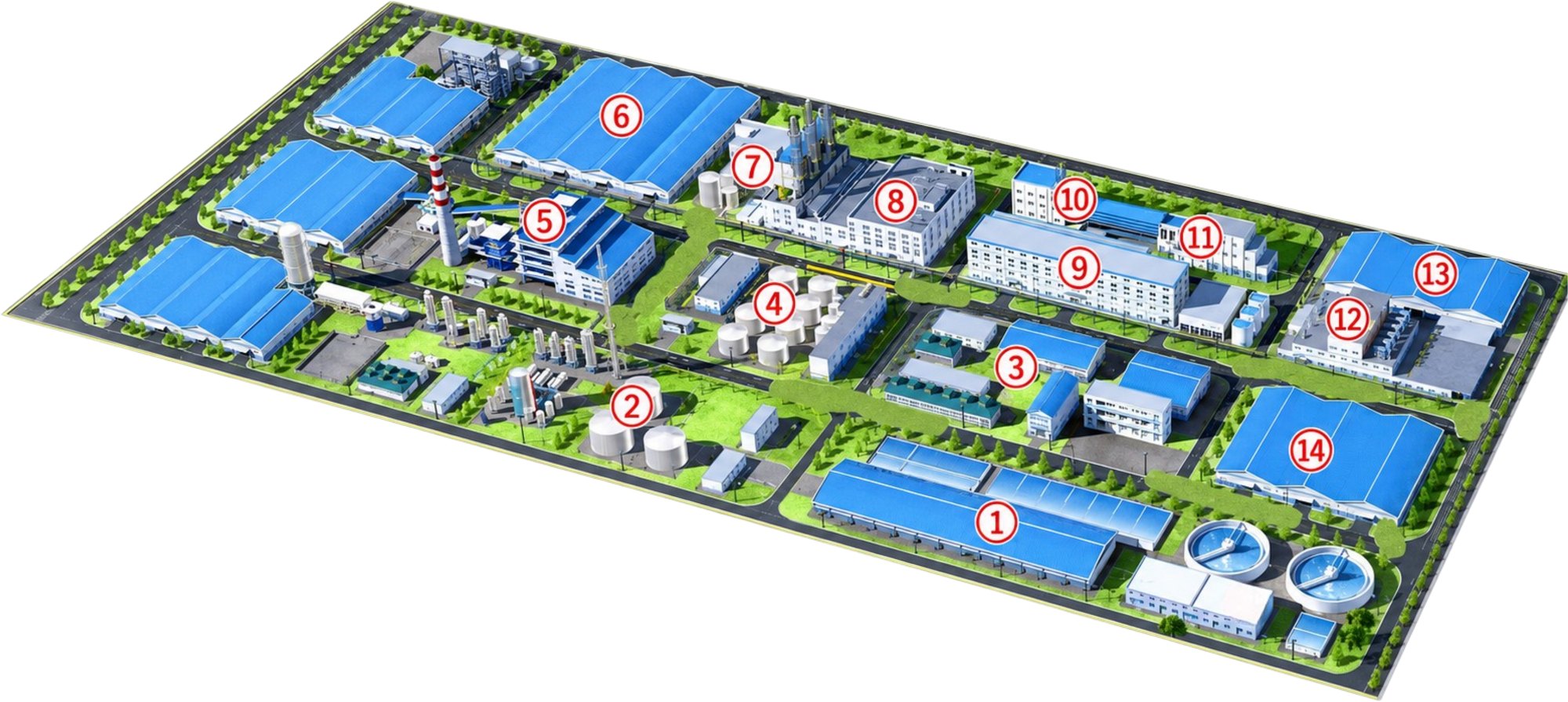
What makes the site work is that almost nothing has to be brought in. Sulphuric acid, steam, process water and effluent treatment are all produced and handled here.
Site plan

Process areas
Hover or tap an area to locate it on the plan.

Process area 06
Ilmenite warehouse
Raw material intake and storage. This is where the line begins — the ore is milled from here into the digestion stage.
The line
Step by step
Ilmenite arrives at one end of the site and finished pigment leaves at the other. Eight steps make the pigment; six more supply and clean up after them.
Supporting the main line
Capacity
Quality and technology
Titanium dioxide is bought on numbers
Brightness, tint tone, dispersibility and residue decide whether a pigment works in a formulation, and those numbers have to be the same in every batch. Each batch is released against a defined internal standard, and a certificate of analysis is issued for every shipment.
Controlled parameters
- TiO2 content
- Rutile content
- Brightness (L)
- b value — tint tone
- Tint reducing power (TCS)
- Volatile matter at 105 °C
- pH
- Oil absorption
- Residue on 325 mesh (45 µm)
- Specific resistance
- Dispersibility (Hegman)
Standards
Our coatings and plastics grades are produced to conform to ASTM D476 and BS EN ISO 591-1:2000 Type R2, and are listed under EINECS 236-675-5, CAS 13463-67-7, Colour Index 77891, Pigment White 6.
Documents
- A certificate of analysis with every shipment
- Safety data sheets and product specifications on request
- Full typical properties for each grade, with the sheets to download
Process technology
Patents and utility models
The plant's process development is protected by a portfolio covering pigment seed preparation, surface treatment and production equipment.
| A method using metatitanic acid to produce the seed of titanium dioxide | 200910115274.4 |
| A surface treatment method in the process of rutile TiO2 production | ZL201310265765.3 |
| A grinding roller detacher for Raymond mills used in titanium dioxide production | 201320237605.3 |
| Flocculant adding device for titanium dioxide deposition | 201320237802.5 |
| Raymond analysis machine for titanium dioxide production | 201320237603.4 |
| Micronizer feeding machine | 201320237801.0 |
| Mud scraping device for titanium dioxide sedimentation tank | 201320238429.5 |
| A disc filter vacuum suction system in the titanium dioxide production process | ZL201320238431.2 |

On the site
Raw material storage
Feedstock is held on site, so the acid plant and the pigment line are not waiting on deliveries.
Safety and environment
Everyone goes home
Our target is zero incidents and zero harm — to our employees, to our contractors and to the people who live around the plant. That target is only reachable if it is owned by everyone on site and visibly led from the top, and that is how we run it.
Closing the loop on site
A sulphate process plant is judged by what it does with what it does not sell. At TIKON, spent acid is concentrated and returned to the process rather than discharged, effluent is treated in our own facility on site, and heat from the process is recovered through the boiler system.
Our commitments
- Prevent unplanned environmental impacts and minimise our environmental footprint
- Operate within the environmental permits and standards that apply to our site
- Keep improving process efficiency, so that less input produces the same output
Enquiries
Talk to our technical team
Tell us the system, the process temperature and the property you are optimising for. We will recommend a grade and send a sample.
Contact us